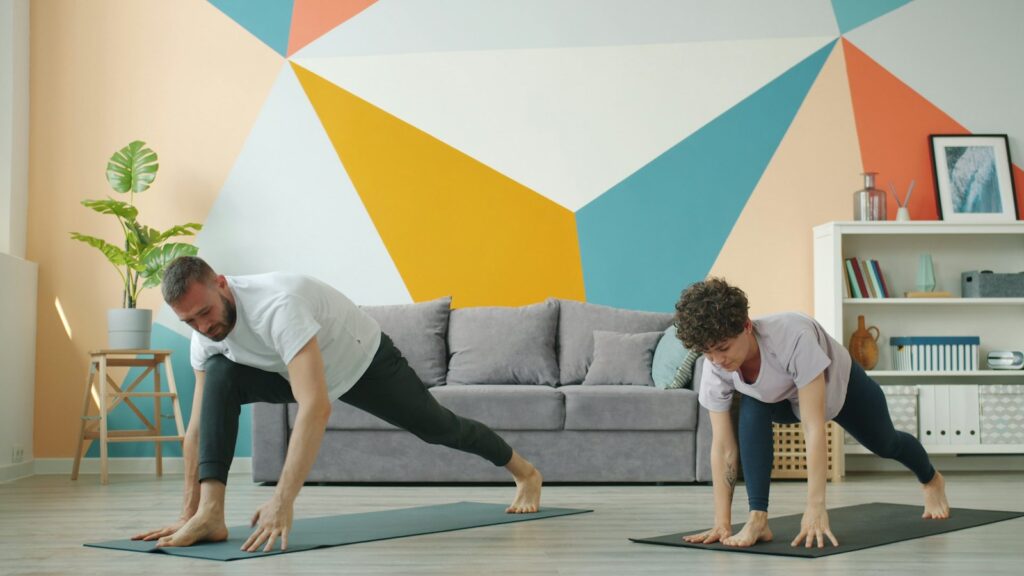
Nobody plans to feel stiff. It simply builds up: an hour of email hunched toward a laptop, a commute, an evening on the sofa, then the same again tomorrow. By Thursday, turning to check a blind spot takes more effort than it should.
Why desk-heavy days leave you stiff
Bodies get good at whatever we do most. Long spells of sitting hold the hips bent, round the shoulders forward and let the head drift ahead of the spine. None of those positions is a problem on its own. The trouble is the lack of variety. Muscles and joints that rarely travel through their full range tend to feel less willing to go there when you finally ask them to.
You may recognise a few of these after a busy week at a desk:
- The front of your hips feels tight when you stand up after a long meeting.
- Your shoulders creep up toward your ears while you concentrate.
- Your neck feels reluctant to turn fully to one side.
- Reaching for your shins in a forward fold feels further away than it used to.
 Desk break
The encouraging part is that you do not need an hour-long class to change how your day feels. Short, regular movement breaks are usually easier to keep up than occasional long sessions, and consistency is what turns stretching from a good intention into a routine you barely have to think about.
The rest of this guide covers the difference between flexibility and mobility, six beginner-friendly stretches with form cues, a practical method for building the habit, and where a guided app fits in.
Mobility vs flexibility, in plain words
The two words get used interchangeably, but they describe slightly different things. Knowing the difference makes it easier to choose what to do with your ten minutes.

Flexibility
How far a muscle can lengthen when something else does the work: gravity, your hands, a strap or the floor. Picture easing into a forward fold and letting it settle for a few slow breaths.
Held stretches tend to sit in this camp. They are calm, quiet and a good fit for winding down.
Mobility
How well you can move a joint through its range under your own control. Picture rolling your shoulders in a big, slow circle without shrugging, or moving through cat-cow in time with your breath.
Mobility work is active and rhythmic. It is a nice way to wake up in the morning or between tasks.
You want a bit of both. Flexibility gives you room to move; mobility lets you use that room on purpose. Most well-designed routines blend slow holds with gentle, controlled movement, which is why the examples in this guide mix the two.
Six stretches worth knowing
These are common, beginner-friendly moves. The form cues are general guidance: move slowly, breathe normally and never push into pain.
Neck rolls
Let your chin drop toward your chest, then slowly roll one ear toward a shoulder, back through the centre and over to the other side.
Form cue: keep it to half-circles in front, skip rolling the head backwards, and let your shoulders stay heavy.
Chest opener
Clasp your hands behind your back, or hold a towel between them, then lift your chest and gently draw your shoulder blades together.
Form cue: lift through the breastbone rather than arching the lower back, and keep your chin level.
Hip flexor stretch
From a half-kneeling position, tuck your pelvis slightly and shift your weight forward until you feel the front of the back hip open.
Form cue: pad the kneeling knee, keep your torso tall and gently squeeze the glute on the kneeling side.
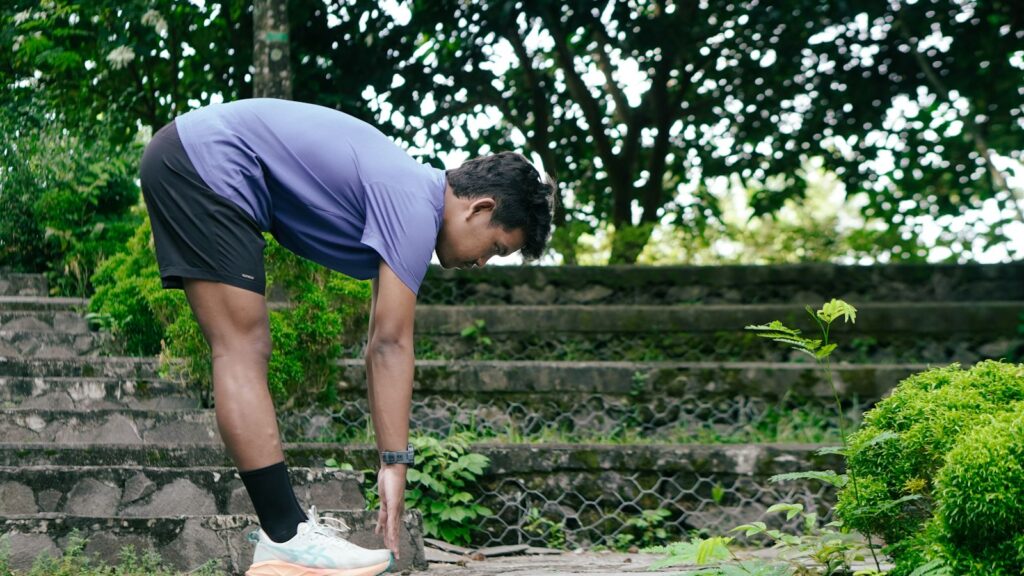
Hamstring fold
Stand with soft knees and hinge forward from the hips, letting your arms and head hang toward the floor.
Form cue: bend your knees as much as you need, and roll up slowly so you do not feel light-headed.
Cat-cow
On hands and knees, round your spine up toward the ceiling, then let your belly lower and your chest lift, moving in time with your breath.
Form cue: hands under shoulders, knees under hips, and keep the range comfortable rather than maximal.
Figure-four
Lying on your back or sitting on a chair, cross one ankle over the opposite knee, then gently draw the legs toward you or lean forward a little.
Form cue: flex the crossed foot, keep the pressure light and give both sides equal time.
The routine you actually do on a busy Tuesday is worth more than the perfect one you keep meaning to start.
The idea behind every routine in this guide
How to make stretching a habit, not a resolution
Motivation is unreliable. A good system makes the decision for you, so you are not negotiating with yourself every morning.
Stack it onto something you already do
Habit stacking means attaching a new behaviour to an existing one. “After I put the kettle on, I do neck rolls and a chest opener.” The kettle becomes the cue, and you never have to remember to stretch.
Same time, same place
Pick a slot that is already predictable: straight after waking, right after lunch, or when you close the laptop for the day. Keep a mat or towel in the same spot so there is nothing to set up.
Start almost too small
Two minutes is a perfectly good first week. The aim early on is to make showing up automatic, not to finish a full session. Once the habit holds, adding minutes is easy.
Let a streak do some of the work
Seeing a run of completed days is surprisingly motivating, and it gives you something small to protect. If you miss a day, simply start again the next. A streak is a nudge, not a test.

A gentle first fortnight
Days 1 to 3: two minutes after brushing your teeth. Days 4 to 7: five minutes, adding one new stretch. Week two: try the full ten-minute morning sequence on weekdays and a desk break on your busiest afternoons.
Stretching after workouts
After a run, a gym session or a long walk, a few minutes of easy stretching is a calm way to shift down a gear. Your body is already warm, which tends to make slow holds feel more comfortable than they do first thing in the morning.
Keep it relaxed: choose the areas you just used, hold each stretch for several slow breaths, and avoid bouncing. A hamstring fold and hip flexor stretch after running, or a chest opener and figure-four after a strength session, are simple places to start. Think of it as a cool-down ritual that signals the workout is over.

Why a guided app helps it stick
The hardest part of any habit is the moment of deciding what to do. Standing on a mat wondering which stretch comes next is exactly when most people give up. A guided routine removes that friction: you press start and follow along.
Bend is a third-party stretching and movement app for iPhone and Android built around that idea. It offers hundreds of exercises and routines, each with illustrations, videos and easy-to-follow guidance, and it is designed for all ages and experience levels. You can choose target areas, pick short routines for the morning, after exercise or as a posture break during work, or create your own routine from a curated exercise library.
Two features line up neatly with the habit method above. Reminders act as your cue at the time you choose, and streaks and progress tracking give you that small, satisfying record of days completed. A free trial is available; check the current subscription price in the app store listing before you commit.
A quick health note
This article is general information, not medical advice. If you have an injury, a health condition, are pregnant or are new to exercise, consult a healthcare professional before starting a stretching routine. Move within a comfortable range and stop if you feel pain, dizziness or numbness.
Want the routines above guided step by step, with reminders and a streak to keep?
Get the App